Guide
How to find the studs in a wall, and fixings that will hold
Studs usually sit 400mm or 600mm apart, and a stud detector or a magnet on the screw heads finds them. Heavy things go into a stud or a nogging; cavity fixings in the board are for lighter loads.
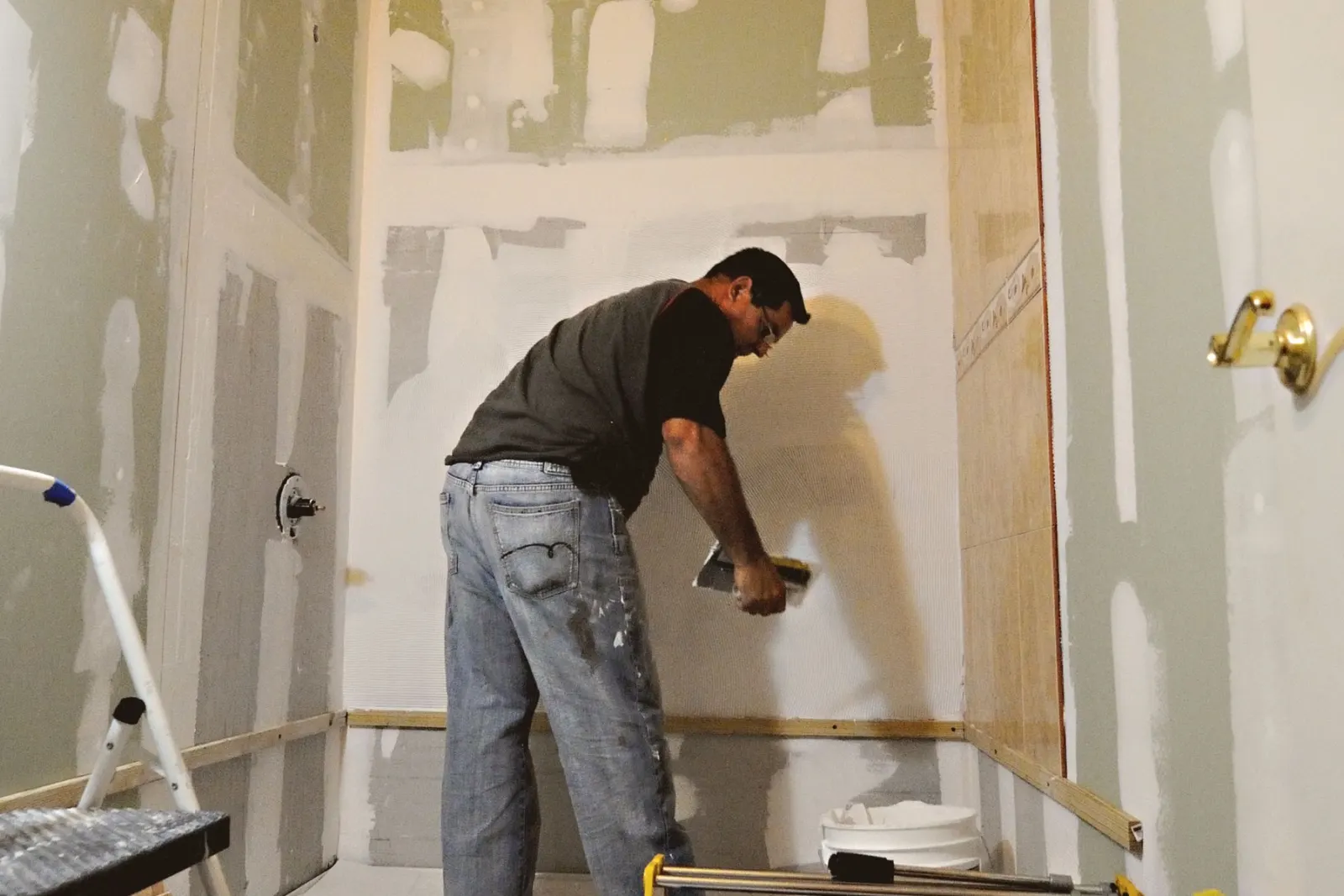
Is it actually a stud wall?
A stud wall sounds hollow almost everywhere and gives a duller, solid note at regular intervals where the timber or metal uprights are. Plasterboard fixed straight to brick or block with blobs of adhesive, known as dot and dab, also sounds hollow in places, but there is masonry a couple of centimetres behind the board.
Drill a small hole somewhere it will be hidden and the dust tells you. White dust all the way through is plasterboard over a void. White, then red or grey, means masonry behind, and that wall takes ordinary wall plugs that go through the board into the brick.
Finding the studs
- Stud detector. The quickest way. Run it horizontally across the wall and mark both edges of each stud it finds, then check against another method.
- Magnet. A strong magnet slid over the wall will stick to the screw heads holding the board, and they run in vertical lines up each stud.
- Measure. Plasterboard sheets are 1200mm wide, so studs are usually at 400mm or 600mm centres. Find one, and the next is likely at the same spacing.
- Sockets and switches. Back boxes in a stud wall are often fixed to the side of a stud.
- Test hole. A thin drill bit or a bradawl through the board where the item will hang. Wood dust or resistance means you have found timber.
Expect extra timber where you do not see it coming: noggings running horizontally between studs, and doubled studs around door openings.
Cables and pipes
The IET's guidance on BS 7671 says cables buried in a wall should run within 150mm of the ceiling or a corner, or straight up, down or across from a socket or switch. Avoid drilling in those lines. In a stud wall, cables can also run horizontally through holes in the studs, and older or DIY wiring may not follow the rules at all, so a detector and a careful first hole are worth the time.
A stud often has a cable or pipe clipped to its side for exactly the reason that it is the obvious thing to fix to, so go into the centre of the stud rather than the edge.
Which fixing for which load
| What you are hanging | Fixing |
|---|---|
| Pictures, light frames, small shelves | Plastic plasterboard plugs or self-drill anchors |
| Mirrors, curtain poles, light cabinets | Metal cavity fixings: hollow wall anchors or spring toggles |
| TV brackets, kitchen wall units, basins, heavy shelves | Wood screws into studs or noggings |
Every cavity fixing packet gives a load rating for a given board thickness. Treat it as the maximum for a weight hanging straight down, and allow a lot less for anything that sticks out from the wall, like a shelf or a TV arm, because leverage pulls the fixing out of the board rather than down it.
Hanging a TV
A flat TV on a fixed bracket is well within what a stud wall can carry, as long as the bracket is screwed into studs and not just into the board. Most brackets are wide enough to reach two studs at 400mm centres. If the studs are in the wrong place for where you want the screen, a plywood board fixed across two studs gives you a strong base to mount the bracket anywhere along it.
Extending arms are the ones to be careful with. Pulled out from the wall, the arm multiplies the force on the top fixings, so they need studs, not cavity fixings.
Metal studs
Newer partitions and most flats and commercial buildings use light steel studs. Wood screws do not hold in them. Use self-tapping screws into the stud, or metal cavity fixings designed for metal stud, and keep heavy loads to points where the builder fitted timber or steel reinforcement.
A magnet still finds metal studs, and finds them more easily than timber ones, because it sticks to the stud itself as well as to the screws. If you are not sure which you have, a test hole tells you straight away: a drill bit that stops dead on something thin and hard is steel.
Plan the fixings before the board goes on
If you are having a new stud wall built, decide now where the TV, kitchen units, shelving or a wall-hung basin will go, and ask for noggings at those points. Take photos of the open framing with a tape measure in shot before it is boarded. It costs almost nothing at that stage and saves a lot of guessing later.
Common questions
How much weight can a stud wall hold?
It depends on the fixing far more than the wall. Screws into a timber stud take heavy items such as wall units and TVs. A cavity fixing in the board alone is limited to the rating on its packet, and less for anything that projects.
Can you hang a TV on a stud wall?
Yes, with the bracket screwed into the studs or into a plywood board fixed across them. Do not rely on cavity fixings in the board alone, especially for an extending arm.
Why does my wall plug just spin in the hole?
Ordinary plastic plugs are made for masonry and have nothing to grip in hollow board. Use a plasterboard fixing, or find the stud. If the hole is now too big, fill it and drill a fresh one slightly to the side.
Can I screw into a metal stud?
Yes, with self-tapping screws or fixings made for metal studs. Wood screws will not hold.