Guide
Plasterboard patch repair: how to fix holes of any size
Screw holes take filler. Holes up to a few centimetres take a mesh patch, a fist-sized hole needs a backing piece behind it, and anything bigger gets a new piece of board cut back to the studs. Check for cables before you cut.
First, what is the wall made of?
Knock on it and look at the edge of the hole. A thin layer of grey or white board with paper on both faces and a hollow behind is plasterboard on studs. Board with blobs of plaster behind it and brick or block a couple of centimetres back is dot and dab. Solid plaster a centimetre or more thick, with masonry directly behind, is a traditional wet plastered wall.
The repair below depends on which you have. Plasterboard is patched with board, mesh and jointing compound. Solid plaster is filled with plaster.
Before you cut anything: cables and pipes
Holes in walls are often near a socket, a switch or a light, which is exactly where cables run. The IET's guidance on BS 7671 sets out the zones where cables buried in a wall are allowed to run: within 150mm of the top of the wall or a corner, and straight up, down or across from a socket, switch or other accessory.
That tells you where cables should be, not where they are. Older wiring and DIY work often ignore the zones, and pipes have no zones at all. Turn off the circuit if you are working near an accessory, run a cable and pipe detector over the area, and make your first cut shallow with a hand saw rather than a power tool.
Repairs by size
| Size of damage | Repair |
|---|---|
| Screw holes, nail holes, small dents | Filler in two thin passes, sanded flat |
| Holes up to about 5cm | Self-adhesive mesh patch and jointing compound |
| Holes up to about 15cm, the fist hole | Square cut, timber backing pieces, new board piece |
| Bigger than that, or board soft from water | Cut back to the studs, new board, joints taped |
Filler shrinks as it dries, which is why every repair above uses two or three thin coats rather than one thick one. The second coat fills the dip the first one left.
Fixing a fist-sized hole step by step
- Draw a square round the damage, a little bigger than the hole, and cut it out with a plasterboard saw.
- Push two strips of timber through the hole and screw them through the board above and below the opening, so they bridge it from behind.
- Cut a piece of plasterboard of the same thickness to fit the square and screw it to the timber strips.
- Tape the four joints with paper or mesh tape bedded in jointing compound.
- Apply two or three thin coats, each one wider than the last, letting each dry.
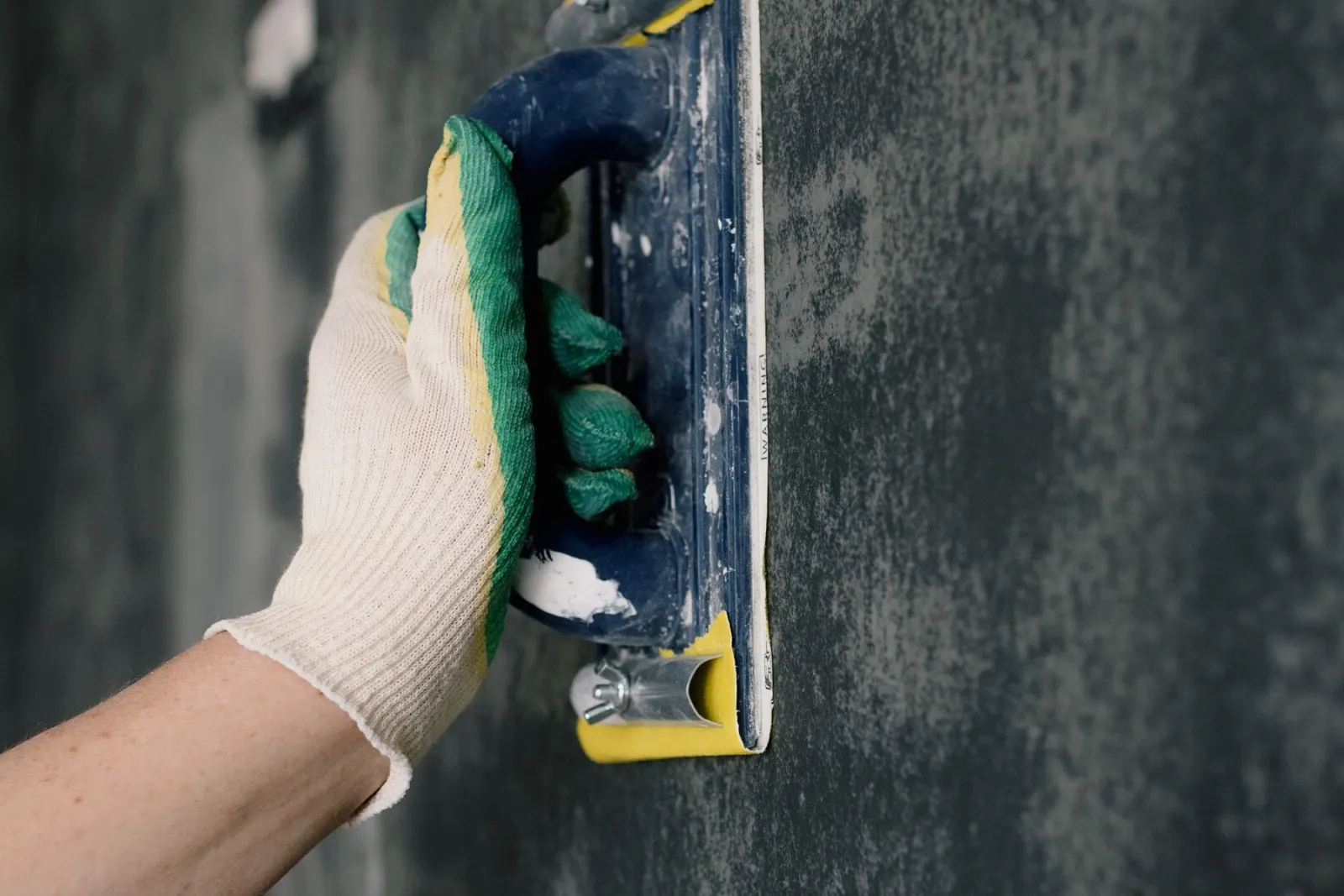
- Sand lightly, feathering the edges into the wall, and mist coat before painting.
The usual giveaway on a DIY patch is a raised square under a raking light. Feathering the final coat out well beyond the patch is what hides it.
Holes in solid plaster
On a wet plastered wall, rake out any loose material until the edges are firm, and brush out the dust. Dampen the hole so the old plaster does not suck the water out of the repair.
A deep hole is built up in layers of backing plaster or a one-coat plaster, each scratched to key the next, then finished with a thin coat flush to the wall. Filling a deep hole with ready-mixed filler in one go is what leaves a dip a few weeks later as it shrinks.
Nail pops and cracks along ceiling joints
A small round bump or crack in a ceiling, in a line, is usually a nail or screw head pushing through as the timber joists dry and move. Drive a plasterboard screw in just beside it to pull the board tight to the joist, tap the old nail back below the surface, and fill both.
A straight crack along a board joint is the joint opening, and it needs taping rather than just filling. Our cracks guide covers the cracks that point to something more than a loose board.
When to call a plasterer
A single patch is well within reach of a careful DIYer. A plasterer is worth it when there are several patches on one wall, when the wall faces a window and every ripple shows, or on a ceiling. Several patches on one wall are often better skimmed as a whole than blended one by one.
Most plasterers charge a minimum of half a day for small repairs, so grouping every hole and crack in the house into one visit is what makes it worthwhile.
Common questions
Can I use filler for a large hole in plasterboard?
No. Filler needs something behind it. Anything bigger than a few centimetres needs a mesh patch or a backing piece and a new section of board, then jointing compound over the joints.
What is the difference between filler and jointing compound?
Filler is made for small holes and sets hard in a small area. Jointing compound is made for taping plasterboard joints and feathering over wide areas, and it sands more easily.
How do I fix nail pops in a plasterboard ceiling?
Put a plasterboard screw beside each pop to pull the board back onto the joist, tap the old nail below the surface, then fill both in two thin passes and sand.
Will a patched wall need skimming?
Not if the patch is feathered out well and the wall is painted with a matt finish. On a wall lit from the side, or one with several patches, a skim over the whole wall gives a more even result.