floors
Floor screeding
Floor screed costs £18 to £35 per square metre laid, depending on depth and type. Liquid anhydrite screed goes down faster and flatter than sand and cement and is what most underfloor heating installations now use.
What this covers
What it costs. Sand and cement screed costs £18 to £28 per square metre laid. Full cost breakdown.
What the job covers
- Sand and cement screed over insulation on a new slab
- Liquid anhydrite screed on an underfloor heating manifold
- Latex levelling a floor before tile or vinyl goes down
- Laying to falls in a wet room
- Screeding to a set depth and laser level across a large bay
What is involved
A screed is the layer between the structural floor and whatever you walk on. It levels, it carries the load out to the slab, and on an underfloor heating job it is the thing that actually stores and releases the heat, which is why depth over the pipes matters more than depth overall.
Sand and cement is laid by hand, ruled off to level and trowelled, typically 65 to 75 millimetres over insulation. It is cheap, it is slow to dry at roughly one day per millimetre for the first 50 millimetres, and getting it flat across a large bay is a skill.
Liquid anhydrite screed is pumped, self-levelling, and goes down at forty millimetres over pipes rather than seventy. It is flatter, faster and lighter, it dries quicker, and it needs the laitance sanding off before anything is stuck to it. It also does not like being permanently wet, so it is the wrong choice for a wet room floor.
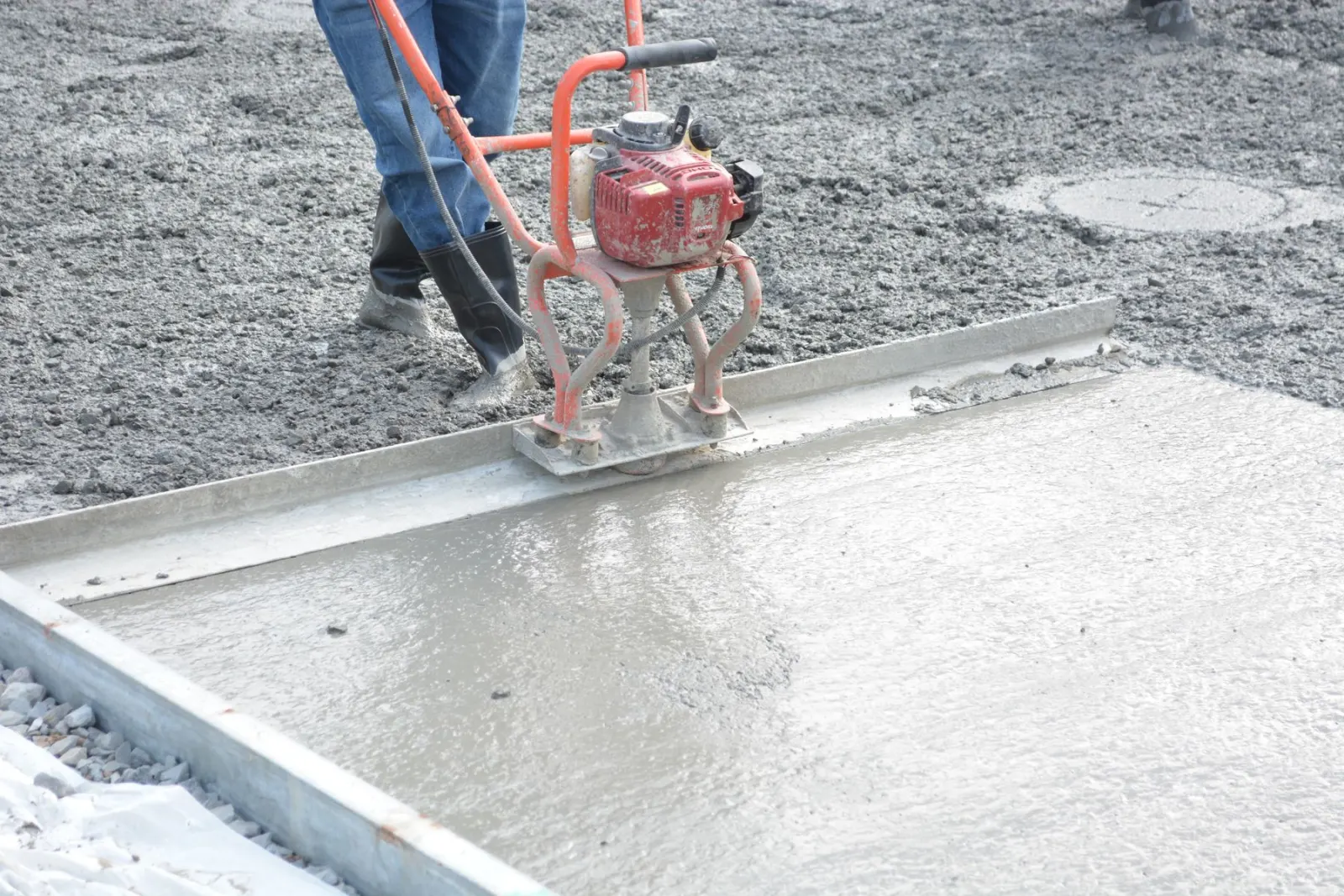
Sand and cement screed over insulation on a new slab, one of the jobs a floor screeding specialist is hired for.
Choosing someone for the job
Ask which screed and what depth, and why that depth. Ask what the drying time is before a floor covering can go down, because it is longer than most people expect and it sits on the critical path of the whole job. Ask whether the price includes the insulation, the membrane and the edge foam. And on liquid screed, ask who sands the laitance off.
Common questions
How long does screed take to dry?
Sand and cement is roughly one day per millimetre up to fifty millimetres, then longer, so a 75mm screed is two to three months before a tight floor covering. Liquid anhydrite is faster, around one day per millimetre to forty and half that rate beyond. Force drying with heating has to be done to a schedule, not by guesswork.
Can you screed over an existing floor?
Over a sound concrete slab, yes. Over timber, only with the right build-up, because a heavy screed on joists is a structural question. For small level differences a latex compound is cheaper and thinner than a screed.